DOCUMENTED MODEL
NM82 NM Flexible Rubber Coupling
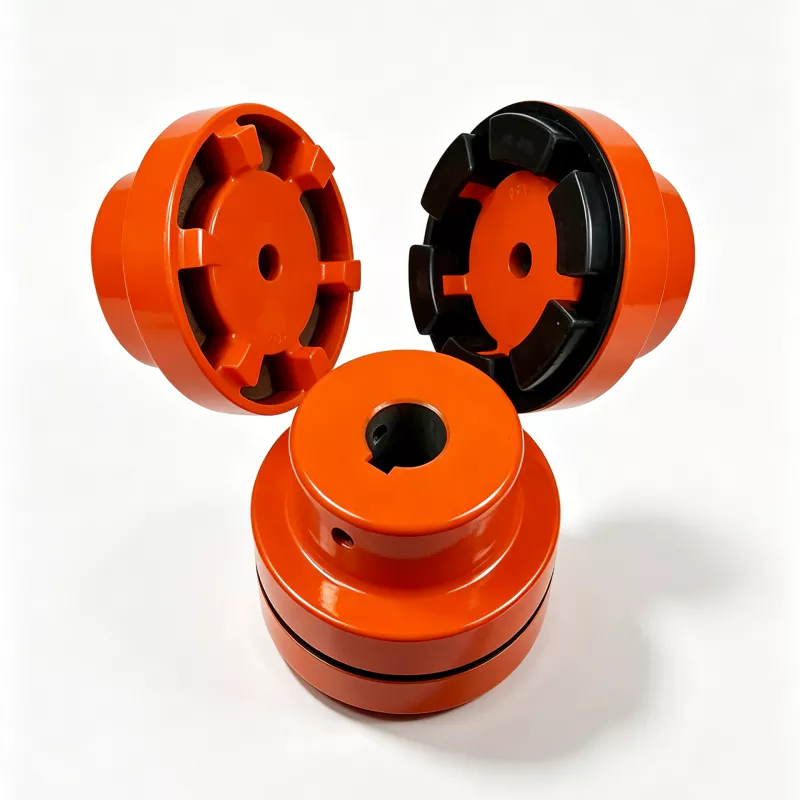
NM82 is a four-lobe NBR flexible coupling size documented at 28 N·m and 3000 rpm. Use it as a catalogue starting point for water pumps, irrigation sets and centrifugal fans; final bore, keyway, material and duty require written confirmation.
28 N·mØ32 mm max boreNBR ring
CATALOGUE EVIDENCE
NM82 dimensions and ratings
Values below are transcribed from the supplied one-page catalogue. They are not copied from a competitor range.
| Nominal torque | Limited speed | D | D1 | Max shaft Ø | Hub length L | Gap S | Radial ΔY | Angular Δα |
|---|---|---|---|---|---|---|---|---|
| 28 N·m | 3000 rpm | 82 mm | 53 mm | 32 mm | 40 mm | 3.0 ± 1.0 mm | 0.05 mm | 3.0° |
Engineering boundary: the catalogue does not state maximum torque, mass, temperature range, Shore hardness, hub grade, keyway standard or balancing grade. Request these when they govern the project.
DECISION CONTEXT
Where NM82 earns a place on the shortlist
NM82 sits at an important water-pump buying point. Its 32 mm documented maximum bore and 28 N·m rating make it a natural comparison size for small pump sets, but final selection must follow actual motor power, speed and duty factor. Pump installers should align after pipework is connected because pipe strain can move the casing and change shaft position. The flexible ring can accommodate limited error; it is not a substitute for a stable baseplate and strain-free piping.
The core audience is pump manufacturers, irrigation dealers and municipal maintenance teams. Their main engineering risk is pump-base alignment after pipe loading. For common small water-pump motor duties, the RFQ should make this risk visible rather than hiding it inside a generic request for “one coupling.” That enables the bore, key, fit, element and duty assumptions to be checked before machining.
Selection, integration and maintenance
An NM coupling transmits torque through two intermeshing hubs and a resilient four-lobe ring. In the supplied catalogue the element is identified as NBR rubber. The ring surrounds the hub jaws, cushions impact and provides torsional damping. Because the element sits between metallic driving features, the coupling can tolerate the limited radial and angular displacement stated for each size. That tolerance is an operating boundary, not an installation target. Lower residual misalignment normally reduces bearing reaction, heating and element wear.
Start selection with machine torque. For a rotating drive, nominal torque in newton-metres can be estimated from power and speed using T = 9550 × kW / rpm. That result describes ideal steady transmission. It must be adjusted for the driven machine, starts per hour, load reversals, jams, process variation and other service conditions. The catalogue rating should exceed the resulting design torque under the supplier's approved selection method. Where a reciprocating compressor, crusher or strongly pulsating load is involved, request a torsional review.
Bore capacity is a separate gate. Both the driver and driven shaft diameters must be at or below the documented maximum, but diameter alone does not approve the hub. Confirm the usable shaft engagement, key width and depth, fit class, shoulder position, chamfers and any axial retention feature. Send a marked-up shaft drawing when the ends differ. The catalogue's NM67-24/25 example demonstrates a clear two-bore identification convention; it does not create a universal stock list.
The dimension S is the assembly gap between opposing hub faces. Set it after both hubs are positioned and before final alignment. If the gap is too small, the hubs may restrict axial movement or contact under thermal growth. If it is too large, the flexible ring may not engage as intended. Use the catalogue tolerance for the chosen size and verify at several rotational positions where practical. Record the measured value on the commissioning sheet.
Alignment should be measured, not judged from the flexibility of the ring. A straightedge and feeler gauge may be adequate for noncritical slow equipment when the equipment maker permits it, while dial indicators or laser tools give better control on sensitive trains. Correct soft foot and base movement first. For pumps, complete piping and check pipe strain before the final reading. Recheck after tightening because a single foot or guard bracket can move the machine.
The coupling requires a fixed guard designed for the machine and local safety rules. The generated application photographs on this website show guards because exposed rotating components are not an acceptable marketing model. Guard design should prevent access, contain credible debris, avoid rubbing and permit inspection only under safe isolation. Do not operate the train for a public demonstration with the guard removed. Lock out all energy before touching hubs, keys or the flexible ring.
Routine inspection looks for cracking, hardening, swelling, missing rubber, dust generation, heat discoloration, fretting, loose retention hardware and changes in vibration or sound. A damaged ring is a symptom as well as a replaceable part. Preserve the removed element long enough to identify whether the likely cause was age, chemical attack, overload, misalignment, heat or incorrect part identity. Replace only with a ring confirmed for the exact NM size and approved material.
NBR is generally selected for useful oil resistance and damping, but exact chemical and temperature suitability depends on the compound. The supplied catalogue page does not publish a temperature range or Shore hardness. Those values must therefore be confirmed in the quotation or material data sheet. The orange, purple and green 92 Shore A, 98 Shore A and 64 Shore D system often seen in polyurethane jaw couplings belongs to a different product system unless the quotation explicitly says otherwise.
Procurement should separate catalogue evidence from configurable supply. Catalogue facts on this site are tagged as documented. Bore machining, keyways, alternative hub materials, alternative elastomer hardness, balancing, coatings and certificates are request items until confirmed in writing. This protects both buyer and manufacturer: an RFQ can ask for the needed configuration without turning an option into a false standard claim. The final drawing and quotation govern the delivered part.
For replacement work, identify the existing coupling from markings, measured outside diameter, hub length, bore pair and element geometry. Do not assume that an NM nominal number is interchangeable with an L-type, ROTEX-style or another supplier's jaw coupling. Compare the complete dimension set and the replacement element. If equipment criticality is high, involve the original machine or train supplier before changing coupling type, stiffness or mass.
Commissioning evidence should be short enough to use and detailed enough to diagnose a repeat problem. Record the chosen model, bore pair, key and fit reference, hub positions, measured face gap, horizontal and vertical alignment results, fastener procedure, guard clearance and unloaded rotation check. Add the operating condition at the first inspection: speed, approximate load, temperature observations, vibration trend and any element debris. Photographs should show the marking and assembled guard without exposing confidential plant information.
A quotation comparison should normalize scope before comparing price. One offer may include finished bores, keyways, retention hardware, an NBR ring, dimensional inspection and export packing, while another may describe rough-bore hubs only. Put each requirement in a compliance table and require the supplier to state included, excluded or deviation. This is particularly important for a wholesale order where one ambiguous bore convention can affect many pieces. The purchase order should reference the final accepted drawing revision.
Storage and spare-parts control also influence reliability. Keep flexible rings away from sunlight, ozone-producing equipment, heat and incompatible chemicals, using the supplier's packaging and shelf-life guidance once provided. Do not mix visually similar elements in one unmarked bin. Label the spare with model, material, order reference and receipt date. For remote or seasonal machines, plan replacement quantity from criticality and lead time rather than claiming universal service life. Rotate stock only when the approved storage rules allow it.
RELATED SIZES
Continue the size comparison
FAQ
NM82 purchasing questions
What is the catalogue torque rating of NM82?
The supplied EVER-POWER catalogue page states 28 N·m nominal torque. Selection must also account for duty, starts, peak torque and shaft fit.
What is the maximum bore shown for NM82?
The documented maximum shaft diameter is 32 mm. A specific bore and keyway still require drawing and quotation confirmation.
Can NM82 run at 3000 rpm?
3000 rpm is the catalogue limited rotational speed. The application must also satisfy torque, balance, alignment, guarding and environmental requirements.
Is a polyurethane spider standard?
No. The supplied catalogue identifies an NBR flexible ring. Polyurethane hardness systems belong to other jaw-coupling designs unless confirmed in the order documents.
Can two different shaft diameters be supplied?
The catalogue marking example uses a two-bore convention. Send both shaft drawings; bore pair, keyways, fits and availability are confirmed in the quotation.