Shock cushioning
The resilient ring can soften torque disturbances and reduce direct metal contact between hub features.
For belt, screw and package conveyors, NM coupling selection is governed by design torque, shaft sizes, alignment and the load pattern. The flexible NBR ring adds damping, while the machine base and guard still carry essential safety roles.
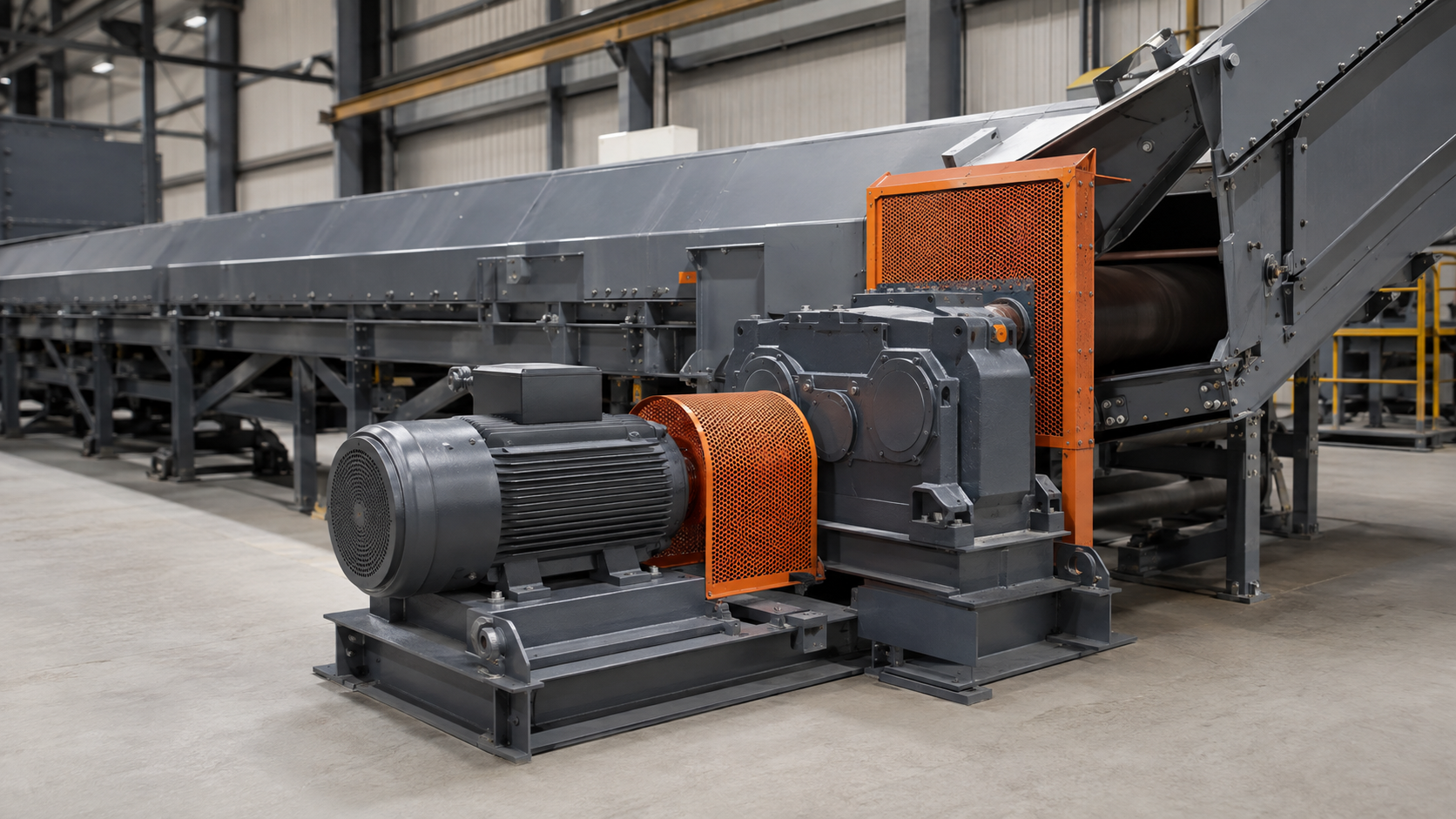
The resilient ring can soften torque disturbances and reduce direct metal contact between hub features.
Catalogue radial and angular values provide size-specific boundaries. Alignment should be better than the allowable limit.
A visible ring condition check supports preventive maintenance when the machine is safely isolated and the guard removed.
The coupling does not correct soft foot, pipe strain, loose bases, bearing faults or structural resonance.
Consider an OEM preparing a drive for belt, screw and package conveyors. The team records motor power, actual speed, the two shaft diameters and the worst operating condition. It then calculates transmitted torque and applies a documented duty factor. The shortlist is checked against the supplied catalogue values, while loaded starts, jams, shock factor and contamination receive separate review.
No operating-hours claim is made. The outcome is a documented RFQ that asks the supplier to confirm the selected size, bore pair, keyways, flexible-ring compound, hub material and delivery scope.
NM112 to NM214 form the main documented high-torque comparison group.
| Size | Nominal torque | Max shaft Ø | Speed limit | Role |
|---|---|---|---|---|
| NM50 | 5 N·m | 19 mm | 3000 rpm | compare by calculation |
| NM67 | 13 N·m | 28 mm | 3000 rpm | shortlist |
| NM82 | 28 N·m | 32 mm | 3000 rpm | compare by calculation |
| NM97 | 45 N·m | 42 mm | 3000 rpm | compare by calculation |
| NM112 | 70 N·m | 48 mm | 3000 rpm | shortlist |
| NM128 | 140 N·m | 55 mm | 3000 rpm | compare by calculation |
| NM148 | 280 N·m | 65 mm | 3000 rpm | compare by calculation |
| NM168 | 500 N·m | 75 mm | 3000 rpm | shortlist |
| NM194 | 840 N·m | 85 mm | 1500 rpm | compare by calculation |
| NM214 | 1000 N·m | 95 mm | 1500 rpm | compare by calculation |
Start with the machine datasheet. Write down rated power, actual operating speed, starts per hour, direction changes, normal and maximum load, ambient temperature, nearby fluids and the expected maintenance window. For variable-speed operation, include the complete speed range. For driven equipment that may start loaded, describe the material or fluid condition rather than relying on a generic label.
Measure both shafts and verify that the selected model has adequate bore capacity. Capture key dimensions and the usable engagement length. Compare the physical envelope D, D1, L and S with the guard and adjacent housings. Plan how installers will position the hubs and how maintenance personnel will inspect or remove the ring. If the existing machine has a different coupling, record its mass and overhang before changing type.
During commissioning, correct soft foot and complete piping or structural work before final alignment. Set the catalogue gap, measure angular and parallel conditions, tighten to the approved procedure and repeat the measurement. Install a compliant fixed guard. After the first loaded operating period, inspect for movement, heat, abnormal sound and element dust. Any correction should be documented so repeat installations begin from evidence rather than memory.
Calculate design torque and confirm both shaft diameters first. The recommended sizes on this page are comparison points, not automatic approvals.
It accommodates limited displacement but does not replace base correction, soft-foot checks and measured shaft alignment.
Custom machining can be requested. Send both shaft drawings; final fit, keyway and material are confirmed in the quotation.
No. Any project scenario on this page is an engineering example, clearly labeled, and not a performance testimonial.